About 360 Political Ecology
360 Political Ecology (360PE) is an independent, interdisciplinary, research-informed platform examining how environmental change, economic systems, political institutions, resource governance and social equity shape sustainable development.
Through 360PE Review, the platform communicates research findings, evaluates competing explanations, examines political-economic and ecological relationships, and explores implications for policy and development.
Guiding principles: Evidence · Ecology · Equity · Development.
Our mission
To generate, synthesize and share credible, evidence-informed knowledge that contributes to fairer, more sustainable and more resilient societies.
360PE seeks to bridge scientific research, public understanding and policy dialogue while maintaining analytical independence, transparency and appropriate recognition of uncertainty.
Our purpose
To make complex environmental and development questions understandable, relevant and actionable for researchers, policymakers, practitioners, students and the wider public—without sacrificing scientific rigor, contextual understanding or important qualifications.
Our work connects empirical findings with the economic, institutional, political and ecological processes that influence environmental outcomes and development opportunities.
What we study
360PE Review organizes its research and analysis around ten official areas of analysis, covering climate change, energy and resource economics, critical minerals, environmental justice and health, environmental governance, ecosystems, sustainability, climate finance, just transition, and international environmental policy and law.
These areas are interconnected. For example, energy transitions raise questions about mineral extraction, investment, industrial development, environmental protection, community livelihoods and the distribution of economic benefits.
The six broad perspectives presented in our institutional overview graphic are illustrative conceptual perspectives, not replacements for the ten official thematic categories.
How we work
360PE combines scientific evidence, interdisciplinary interpretation, political-ecological analysis and policy-oriented communication.
Evidence and research
Draw on traceable scientific, institutional and field-based sources. Explain data definitions, research methods, limitations and uncertainties.
Critical interdisciplinary analysis
Evaluate competing explanations and examine economic incentives, institutional arrangements, ecological relationships and relevant contextual factors.
Justice and distribution
Investigate who benefits, who bears environmental and social costs, whose knowledge is recognized, and who participates in decisions.
Policy dialogue
Assess policy options, implementation constraints, trade-offs and potential development outcomes without treating proposed interventions as proven solutions.
Our five-stage evidence-to-policy framework
360PE Review follows a structured analytical approach designed to connect research evidence with public understanding and policy relevance.
The framework consists of five complementary stages:
Finding: Present the central empirical observation, research result, documented event or relevant quantitative evidence.
Explanation: Clarify what the finding means, including its definitions, geographical and temporal context, methodological limitations and uncertainties.
Expert interpretation: Engage relevant peer-reviewed research, attributable expert perspectives and credible alternative explanations. Distinguish documented expert views from 360PE’s own analysis.
Political-ecological analysis: Examine the economic incentives, institutional arrangements, power relationships, ecological processes and distributional consequences that may explain the observed outcomes. Distinguish established findings from plausible but unverified causal mechanisms.
Wider development and policy implications: Connect the analysis to governance, sustainability, economic development and public policy. Discuss actionable responses, implementation challenges, trade-offs and ways to evaluate outcomes.
These stages guide the analytical development of our publications rather than prescribing an inflexible writing format.
Our editorial approach: Present the evidence. Explain its meaning. Engage expert knowledge. Examine the political-economic and ecological mechanisms. Connect the findings to wider development and policy implications.
What distinguishes 360PE
- Evidence-based: Sources, empirical findings and quantitative claims should be traceable, accurately represented and appropriately qualified.
- Interdisciplinary: Economic, ecological, political, institutional and social perspectives inform our analysis.
- Justice-centred: Distributional consequences, environmental rights and meaningful participation are central analytical concerns.
- Globally informed, locally relevant: Our work pays particular attention to low- and emerging-income economies while engaging with global environmental and development challenges.
- Independent and critically balanced: We examine competing arguments, disclose relevant limitations and distinguish normative positions from empirical or causal evidence.
- Transparent about uncertainty: We identify data gaps, methodological constraints and the limits of available evidence.
- Solution-oriented: Our analysis explores credible policy responses without presuming their effectiveness before adequate evaluation.
Who we serve
360PE serves a diverse audience, including:
- Researchers, academics and interdisciplinary scholars.
- Policymakers, public agencies and regulatory institutions.
- Development organizations and international institutions.
- Financial institutions, investors and sustainability practitioners.
- Civil-society organizations and community-based initiatives.
- Business leaders and professionals working on environmental and development challenges.
- Students, emerging researchers and the wider interested public.
Our aim is to make rigorous environmental and development analysis accessible across academic, policy, professional and public audiences.
360PE at a glance
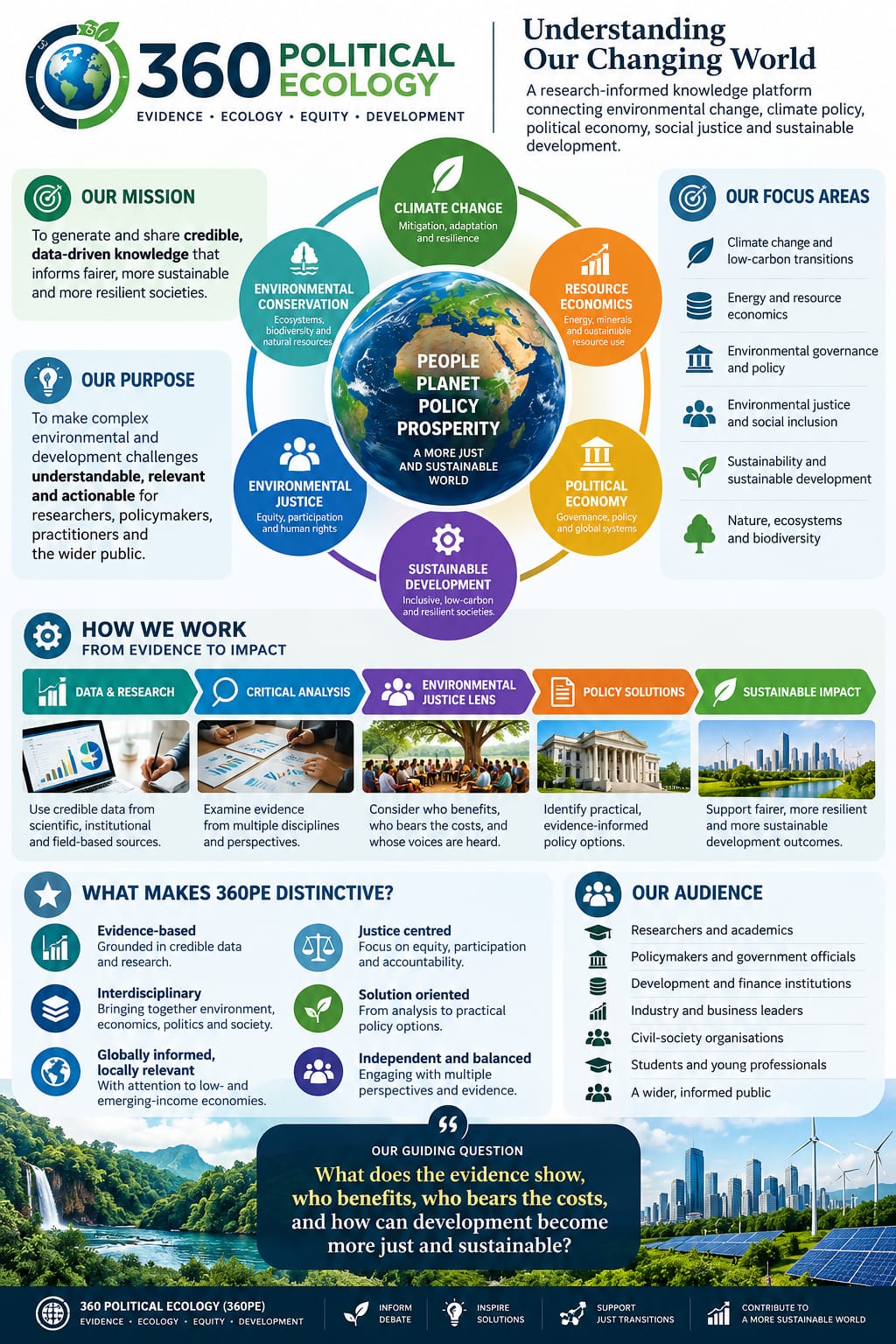
Figure. Institutional overview of 360 Political Ecology (360PE). This public-communication infographic presents six broad conceptual perspectives, which should not be confused with the ten official areas of analysis. Source: 360PE, supplied institutional visual (2026).
Our guiding question
What does the evidence show, who benefits, who bears the costs, and how can development become more just and sustainable?
This question reflects 360PE’s commitment to examining environmental change not only as a scientific issue but also as an economic, institutional, ecological and distributive challenge.
Founder, independence and editorial standards
360 Political Ecology (360PE) was founded by Amanfo Smart Edward, PhD, an interdisciplinary researcher working across environmental and development economics, sustainability and related policy fields.
360PE operates as an independent research-informed communication and analytical platform. Institutional affiliations included in founder or contributor profiles are provided for identification and do not imply institutional sponsorship, endorsement or editorial responsibility.
360PE Review is an independent research-informed publication and is not presented as a peer-reviewed academic journal. Its publications seek to uphold standards of evidence traceability, accurate attribution, analytical transparency, responsible interpretation and clear distinction between research findings, commentary and policy recommendations.
For further information, see our founder profile, editorial standards and contact page.
Meet the founder · Read our editorial standards · Contact 360PE